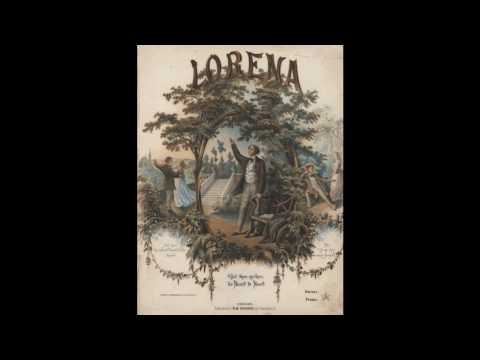
Lorena

Album: Lorena (1857)
Play Video

Songfacts®:

  • "Lorena" was one of the most popular songs in the United States immediately prior to and during the Civil War; based on a true story, its origins are extremely well documented. It started life as a poem by a minister in Zanesville, Ohio, the Reverend Henry De Lafayette Webster (1824-96); he wrote it in 1856 after family opposition blocked his marriage to nineteen year old Ella Blocksom, who sang in his choir. When the relationship was ended, he resigned his post and shortly met Joseph Philbrick Webster, who set it to music. The heroine was originally called Bertha, but the composer altered this because he needed a three-syllable named. Lorena is an adaptation of Lenore, from the Edgar Allen Poe poem The Raven.

    The line, "If we try, we may forget," is taken from Ella's parting letter to Henry. She went on to marry William Wartenbee Johnson, who sat on the Ohio Supreme Court from 1879-'86. She is buried in Woodland Cemetery, Ironton, Ohio.
  • "Lorena" was popular with soldiers on both sides of the conflict; one Confederate officer even blamed it for the South's defeat, reasoning that it made soldiers homesick and ineffective. It established Webster as a composer, and was his most famous song, although "I'll Twine 'Mid The Ringlets" (better known as "Wildwood Flower") would become a big hit long after his death.
  • "Lorena" was first published by H. M. Higgins Brothers of Chicago, in 1857; the Library Of Congress holds a copy printed by J.C Shreiner of Macon, Georgia between 1862 and 1864. It has been published and recorded a number of times since, including a 1950s a cappella arrangement by Ralph Hunter, Robert Shaw and Alice Parker.
    Webster and Webster also wrote an answer song called "Paul Vane or Lorena's Reply," which is essentially more of the same. "Lorena" has been used as incidental music in at least two films, and is the subject of a full-length book, the 1962 treatise The Sweetheart Of The Civil War: The True Story Of "Lorena", written by Ernest K. Emurian. >>>
    Suggestion credit:
    Alexander Baron - London, England, for all above

Comments: 2

  • Tracey from Zanesville, OhioYoung Rev. Henry de Lafayette Webster was a life-long Universalist minister, not a Presbyterian minister..
    Tradition states that it was Lorena Blocksom's married sister and family with whom she lived opposed the marriage.
    Yet, later, another female in that family married a Universalist minister.
    The song was written after Ella Blocksom and Rev. Webster were both married.
  • Lorena M Fuhr from Moose Jaw, SaskatchewanThe lyrics were featured in Margaret Mitchell's 'Gone With the Wind'. The scene was the first social function that Scarlet attended after becoming a young widow. In the 1976 movie 'Missouri Breaks', Marlon Brando play the melody on his harmonica by the campfire.
see more comments

Editor's Picks

Justin Timberlake

Justin TimberlakeFact or Fiction

Was Justin the first to be Punk'd by Ashton Kutcher? Did Britney really blame him for her meltdown? Did his bandmates think he was gay?
Daryl Hall

Daryl HallSongwriter Interviews

Daryl Hall's TV show is a hit, and he's been inducted into the Rock and Roll Hall of Fame - only one of these developments excites him.
Emilio Castillo from Tower of Power

Emilio Castillo from Tower of PowerSongwriter Interviews

Emilio talks about what it's like to write and perform with the Tower of Power horns, and why every struggling band should have a friend like Huey Lewis.
Joe Ely

Joe ElySongwriter Interviews

The renown Texas songwriter has been at it for 40 years, with tales to tell about The Flatlanders and The Clash - that's Joe's Tex-Mex on "Should I Stay or Should I Go?"
Queen

QueenFact or Fiction

Scaramouch, a hoople and a superhero soundtrack - see if you can spot the real Queen stories.

Song Cities

Song CitiesMusic Quiz

Nirvana, Billy Joel and Bruce Springsteen are among those who wrote songs with cities that show up in this quiz.